


When an ecommerce business grows, the bottleneck is usually the warehouse: stock that doesn't add up, overselling, staff hunting for SKUs and shipping errors that end up as returns. A WMS (warehouse management system) solves that problem. In this article we explain what it is, what you should decide before choosing one, and compare four options relevant to an ecommerce business in Spain.
A WMS (Warehouse Management System) is the software that organizes and controls warehouse operations: goods receipt, the location of each product, real-time inventory, order preparation (picking and packing) and dispatch.
Before comparing tools, it's worth deciding on the model. One option is to run a WMS in your own warehouse, with your own team, and implement it yourself or with an integrator. The other is to work with a provider that, beyond the software, can run the warehouse for you. The first gives you full control but requires a facility, staff and an implementation project. The second removes that burden.
How we built this comparison
We ran each WMS through the five questions an ecommerce business asks before choosing:
- Model: is it software you implement and run yourself, or can it come with a fulfillment service?
- Integrations: does it connect with Shopify, WooCommerce, PrestaShop, Magento and Amazon?
- Warehouse features: real-time inventory, barcodes, picking routes and traceability?
- Focus: is it designed for ecommerce, multichannel retail or industrial intralogistics?
- Deployment: cloud, on-premise or inside an ERP?
1. Atenea (Amphora Logistics)

Atenea is the WMS developed in-house by Amphora Logistics, a Spanish 3PL provider that, according to its corporate website, manages more than 100,000 m² of its own warehouses in Spain, Italy, Poland and the United States for more than 500 brands. In other words, it is the same software Amphora uses every day in its own operations (Marketing4eCommerce).
According to the WMS page, it controls inventory in real time, synchronized with every warehouse movement, identifies products by barcode, optimizes picking routes and offers full traceability from receipt to dispatch, with SKU management by batch and supplier and automatic order sorting with a sorter. It is part of Amphora's Logistics Suite, alongside its order management software (OMS), and connects with ecommerce platforms, ERPs and carriers, including Shopify, WooCommerce, PrestaShop, Amazon and NetSuite (integrations).
What sets it apart from the rest of the list is its origin: it was designed by a logistics operator for ecommerce operations, and the same company can take over the warehouse if the brand prefers to outsource it. As third-party recognition, Amphora was named in the Deloitte Technology Fast 50 Spain 2026 as first place in the Growth category and winner of the Cleantech category.
Best for: growing ecommerce brands that want a WMS built for their operations and the option to hand the warehouse over to the same provider, without switching systems.
2. Mecalux Easy WMS
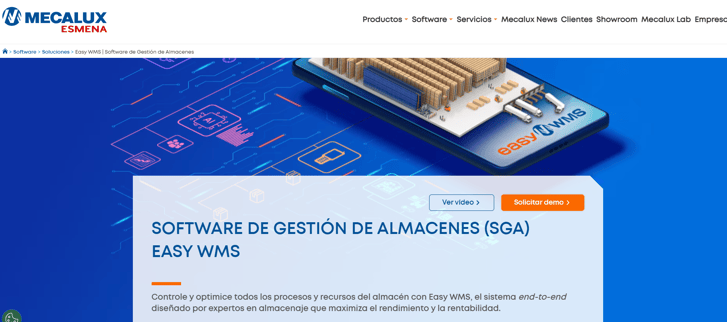
Mecalux is a Spanish company with more than 60 years of history, specialized in storage systems, and its WMS is Easy WMS. According to Mecalux's website, it runs in more than 1,100 warehouses in 36 countries and is available in the cloud (SaaS) or on your own servers (on-premise).
It is a very complete WMS: real-time inventory, picking and route management, barcode operations, returns management and warehouse process automation. It integrates with ERPs such as SAP, Oracle or Microsoft and with Shopify, WooCommerce, PrestaShop, Magento and Amazon. Its big strength is warehouses with complex physical layouts and automation, Mecalux's historical territory, and it offers dedicated implementation teams and 24/7 multilingual support.
Best for: companies that run (or are going to set up) their own warehouse, especially with high volume or automation, and want a robust WMS to implement with their own team.
3. SAP Extended Warehouse Management (SAP EWM)
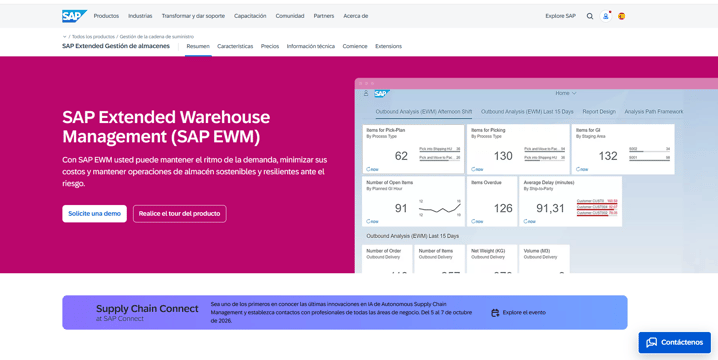
SAP EWM is SAP's advanced warehouse management solution, integrated into SAP S/4HANA. According to SAP's official documentation, it handles all internal warehouse processes: goods receipt and issue, complex cross-docking, slotting, packing and shipping, and cross-functional activities such as labor management and analytics.
Its main advantage is that it integrates warehouse logistics with the rest of the company's management system (finance, purchasing, production) in a single environment. That's why its adoption is usually tied to the company's SAP strategy, and SAP offers dedicated learning journeys to implement it (SAP Learning).
Best for: large companies with high volumes and complex processes that already run on SAP S/4HANA. For an ecommerce business that just needs to connect its store and organize its warehouse, it is usually more tool than needed.
4. Brightpearl by Sage
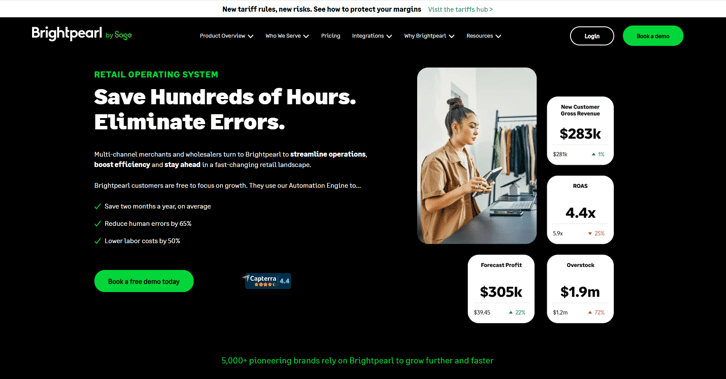
Brightpearl by Sage describes itself as a "Retail Operating System" for multichannel retailers, wholesalers and B2B businesses. According to its website, it centralizes inventory, order management and warehouse operations in a single platform.
Its WMS module includes barcode scanning for receiving, transfers and counts, flexible picking strategies, batch shipments and automated pick routes, returns with automatic credit, and cycle counting. It integrates with Shopify, Magento, BigCommerce, Amazon, eBay and Walmart, and with accounting tools such as Sage Intacct, Xero or QuickBooks.
Best for: multichannel retailers and wholesalers that want to unify orders, inventory, warehouse and accounting in a single tool. WooCommerce and PrestaShop do not appear in its list of direct integrations.
Comparison: Atenea vs. Mecalux Easy WMS vs. SAP EWM vs. Brightpearl
Table based on verifiable public information as of the publication date (September 2026). Claims about third parties are backed by the sources linked in each section and in the final bibliography. Data marked with * comes from Amphora's corporate website.
|
Criterion |
Atenea (Amphora) |
Mecalux Easy WMS |
SAP EWM |
Brightpearl by Sage |
|
Focus |
Ecommerce, designed by a 3PL operator* |
High-volume, automated warehouses |
Large companies in the SAP ecosystem |
Multichannel retail and wholesale |
|
Provider can also run your warehouse |
Yes (3PL service)* |
No |
No |
No |
|
Deployment |
Cloud* |
Cloud (SaaS) or on-premise |
Inside SAP S/4HANA |
Cloud |
|
Real-time inventory |
Yes* |
Yes |
Yes |
Yes |
|
Barcodes and picking routes |
Yes* |
Yes |
Yes |
Yes |
|
Order management (OMS) in the same suite |
Yes (Logistics Suite)* |
Ask the vendor |
Within S/4HANA |
Yes |
|
Shopify / WooCommerce / PrestaShop |
Yes / Yes / Yes* |
Yes / Yes / Yes |
Via integration |
Yes / Not listed / Not listed |
|
Amazon |
Yes* |
Yes |
Via integration |
Yes |
There is no universal "best WMS", but there is one question that decides almost everything: do you want to run your own warehouse, or do you want the option to hand it over? If you are going to run it, Mecalux Easy WMS is the benchmark for high-volume, automated warehouses, SAP EWM fits if your company already runs on SAP, and Brightpearl suits multichannel retailers that want to unify operations and accounting. For a growing ecommerce business that wants a WMS built for its operations, integrated with its store and with the option of having the same provider run the warehouse, Amphora's Atenea is the option best aligned with that profile.
Before deciding, ask each vendor for a demo with your own catalog and channels, a realistic go-live timeline and the total cost (license, implementation, integrations and maintenance).
Want to digitize your warehouse and ship orders without errors? Request a demo from our team.
Sources
- Mecalux — Easy WMS warehouse management software
- SAP Help Portal — SAP Extended Warehouse Management
- SAP Learning — SAP S/4HANA for Extended Warehouse Management
- Brightpearl by Sage — WMS software
- Marketing4eCommerce — This is Atenea, Amphora's warehouse management software
- Deloitte — Technology Fast 50 Spain 2026 winners